Personal Research Infrastructure · Local AI
A fully local document retrieval system for researchers and small businesses with proprietary data – built on the principle that a good system should retrieve and cite, not summarise and synthesise.
G.U.I.D.E. in Use
An interactive demonstration of the G.U.I.D.E. interface – showing a query resolving to a cited passage and navigating through to the document in A.R.C.H.I.V.E.
Context
The Problem
Research workflows accumulate large, unwieldy document collections – PDFs, decks, papers – that outpace any individual’s ability to navigate from memory. Small businesses face the same problem with proprietary internal documents: contracts, reports, policies, and institutional knowledge that needs to be surfaced quickly without being sent to external infrastructure. Cloud-based AI tools promise to help, but do so by processing sensitive documents on remote servers and generating confident-sounding summaries that obscure source material rather than surface it.
The Design Principle
ERIS is a librarian, not a synthesiser. The system is built around a strict constraint: it surfaces relevant passages with precise citations and returns control to the researcher. It does not generate answers, aggregate across documents, or attempt to resolve contradictions.
Null results are treated as valid, correct outputs – not failures to be papered over.
What It Is
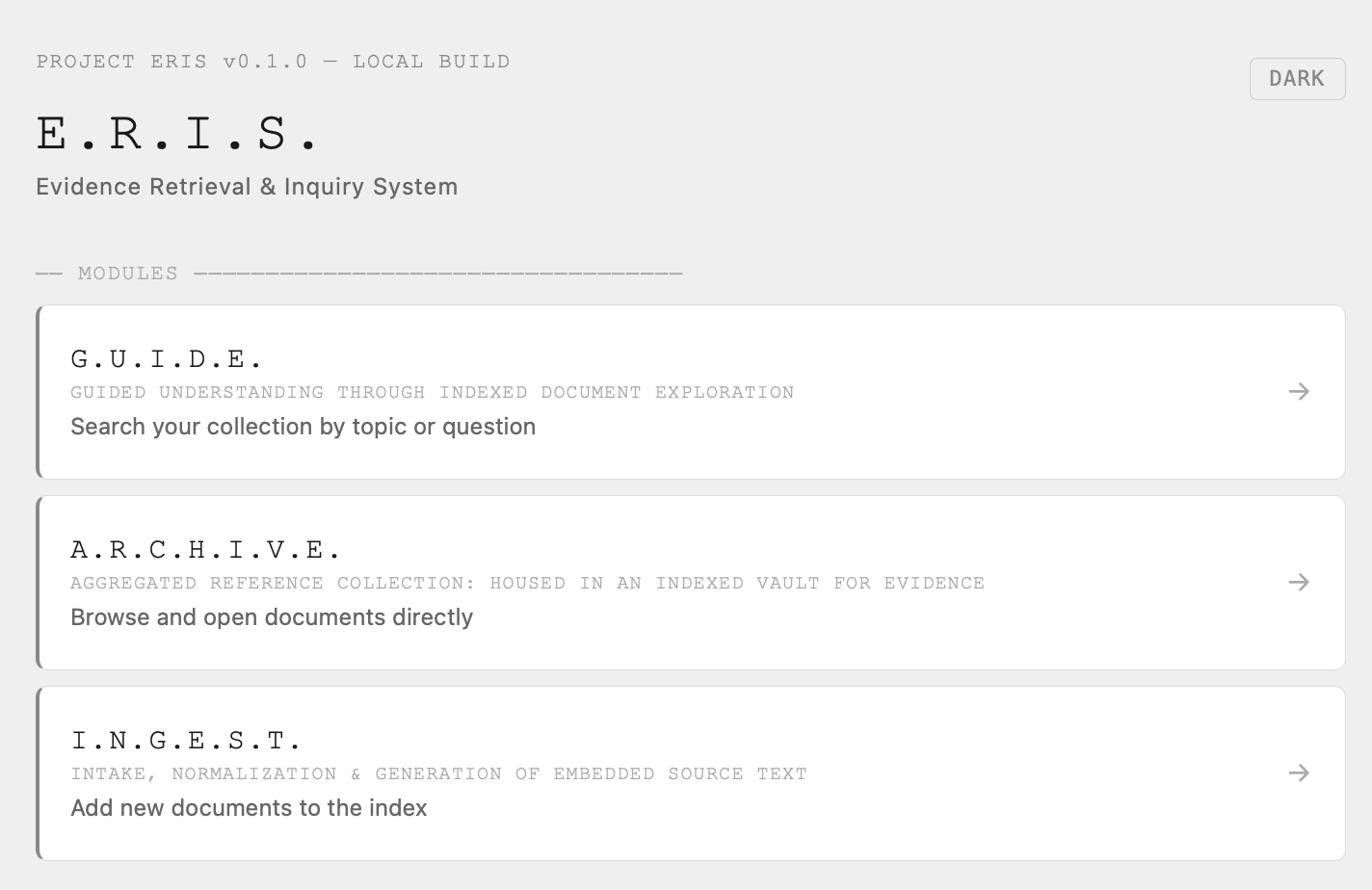
A three-module local system: a semantic search interface powered by a locally-hosted language model, a browsable document library with full-text filtering and inline PDF viewing, and a document processing pipeline for PDF, DOCX, and PPTX files with automated metadata extraction.
Everything runs on local hardware. No documents or queries leave the machine.
Architecture
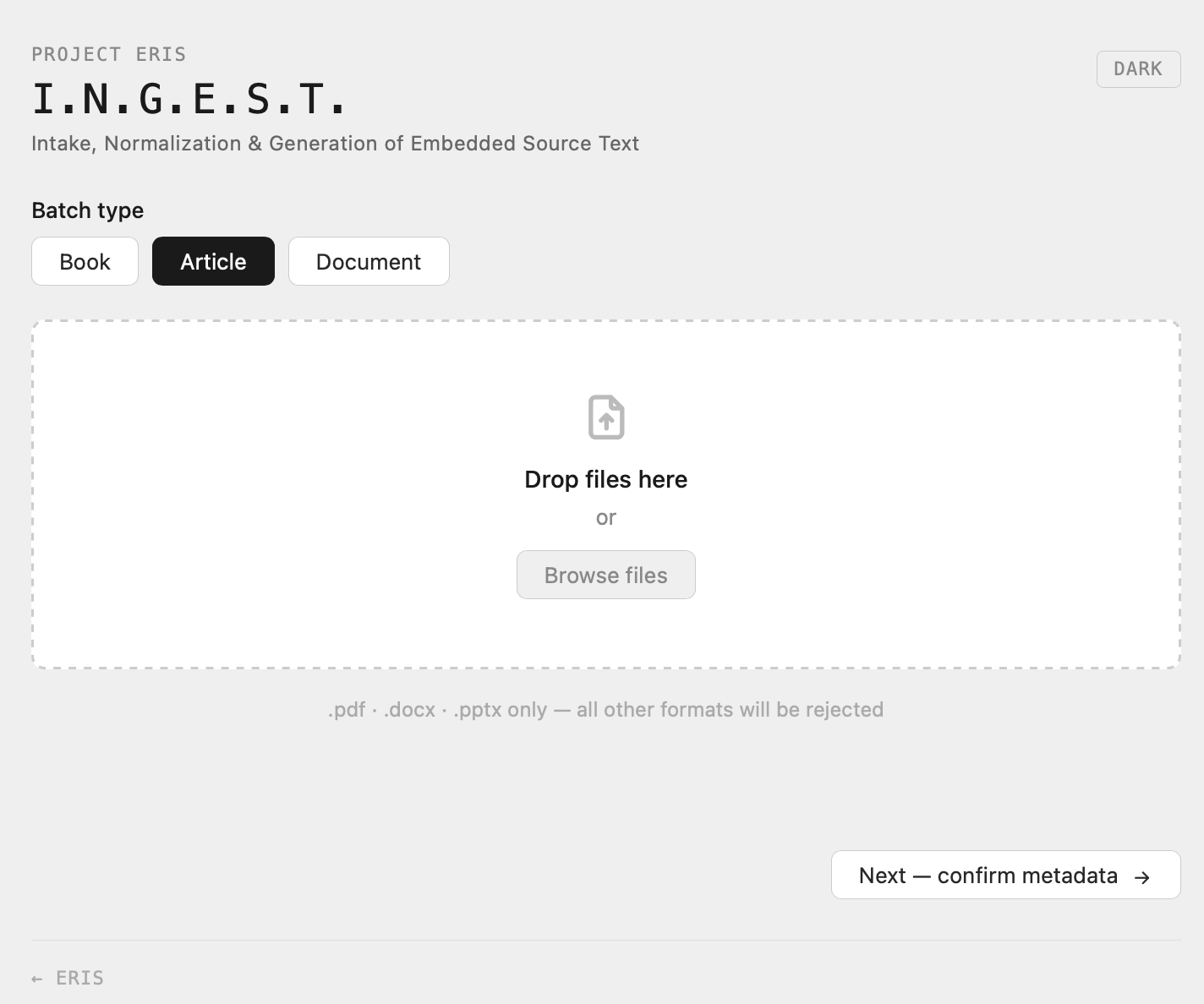
I.N.G.E.S.T.
Intake, Normalization & Generation of Embedded Source Text
The document processing pipeline. Accepts PDF, DOCX, and PPTX files; extracts text via PyMuPDF; chunks with NLTK sentence-aware splitting; generates embeddings via Sentence Transformers (all-MiniLM-L6-v2); and stores vectors in ChromaDB. Automated metadata extraction is confirmed by the user before indexing.
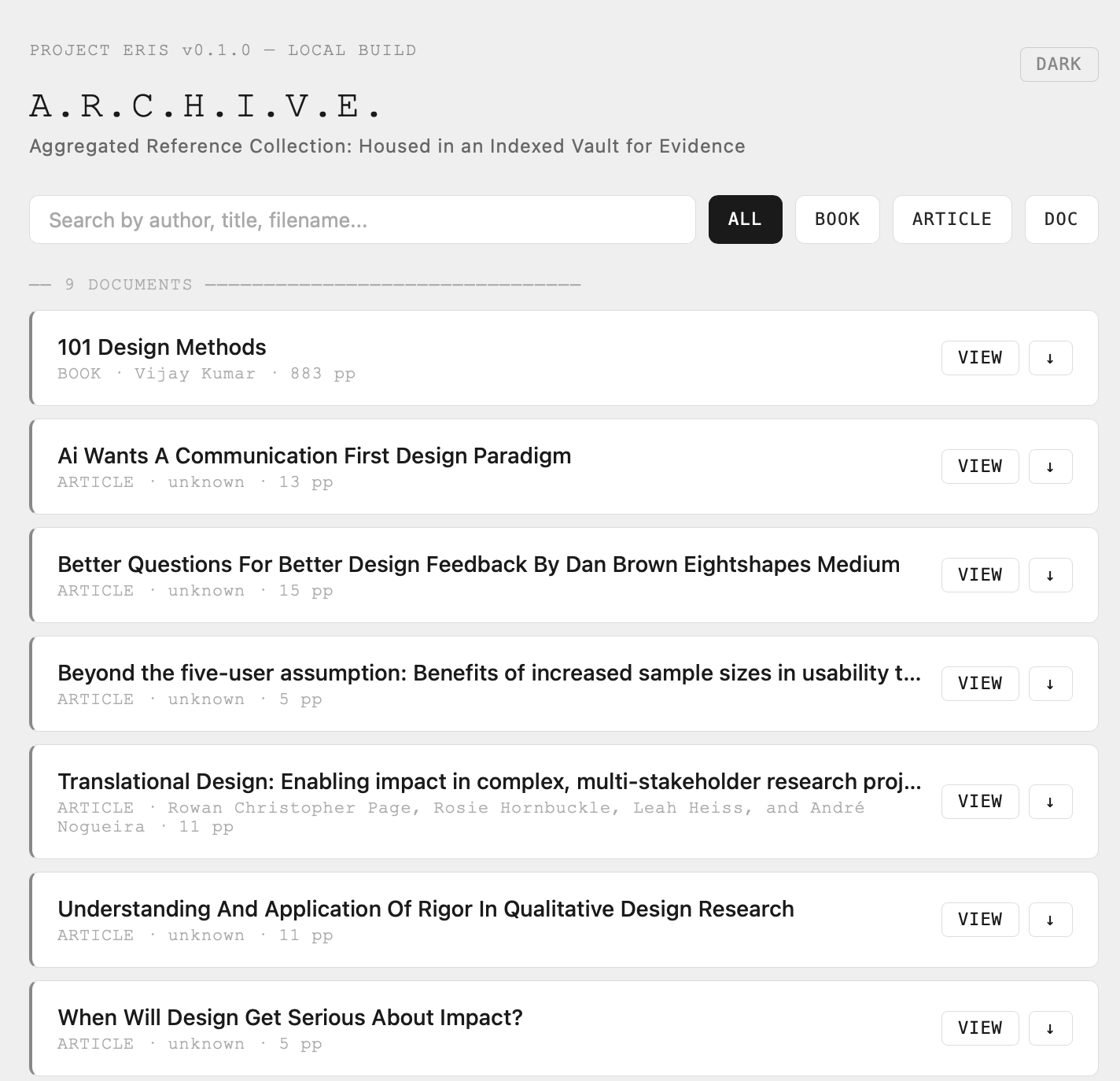
A.R.C.H.I.V.E.
Aggregated Reference Collection: Housed in an Indexed Vault for Evidence
A browsable document library with filtering by document type, full-text search by title and author, and inline PDF viewing and download. The human-readable complement to GUIDE’s query interface.
G.U.I.D.E.
Guided Understanding through Indexed Document Exploration
The semantic search interface. Surfaces relevant passages from the indexed collection with source citations. Powered by a locally-hosted Mistral model via Ollama.
Process
The starting point was a document collection too large to read – old project files, ebooks, academic articles accumulated over years, with no realistic path to reading all of it and no way to know what was relevant when. At the same time, organizations trying to adopt AI tools were running into real governance problems: uncertainty about where data was being sent, how it was being processed, and what that meant for proprietary or sensitive material.
Both problems had the same solution. A local AI that could perform contextual search across a document collection without the documents leaving the machine. And because AI can lack transparency and hallucinate, a core design principle followed directly: document surfacing over information synthesis. The system finds and cites; the researcher concludes.
Scaling the corpus and upgrading the hardware to support a more capable model.
The System
The ERIS home screen (top) with entry points to all three modules. INGEST (bottom left) handles document intake – batch typed, dropped in, confirmed before indexing. ARCHIVE (bottom right) provides a browsable, searchable view of the full indexed collection.
Hardware
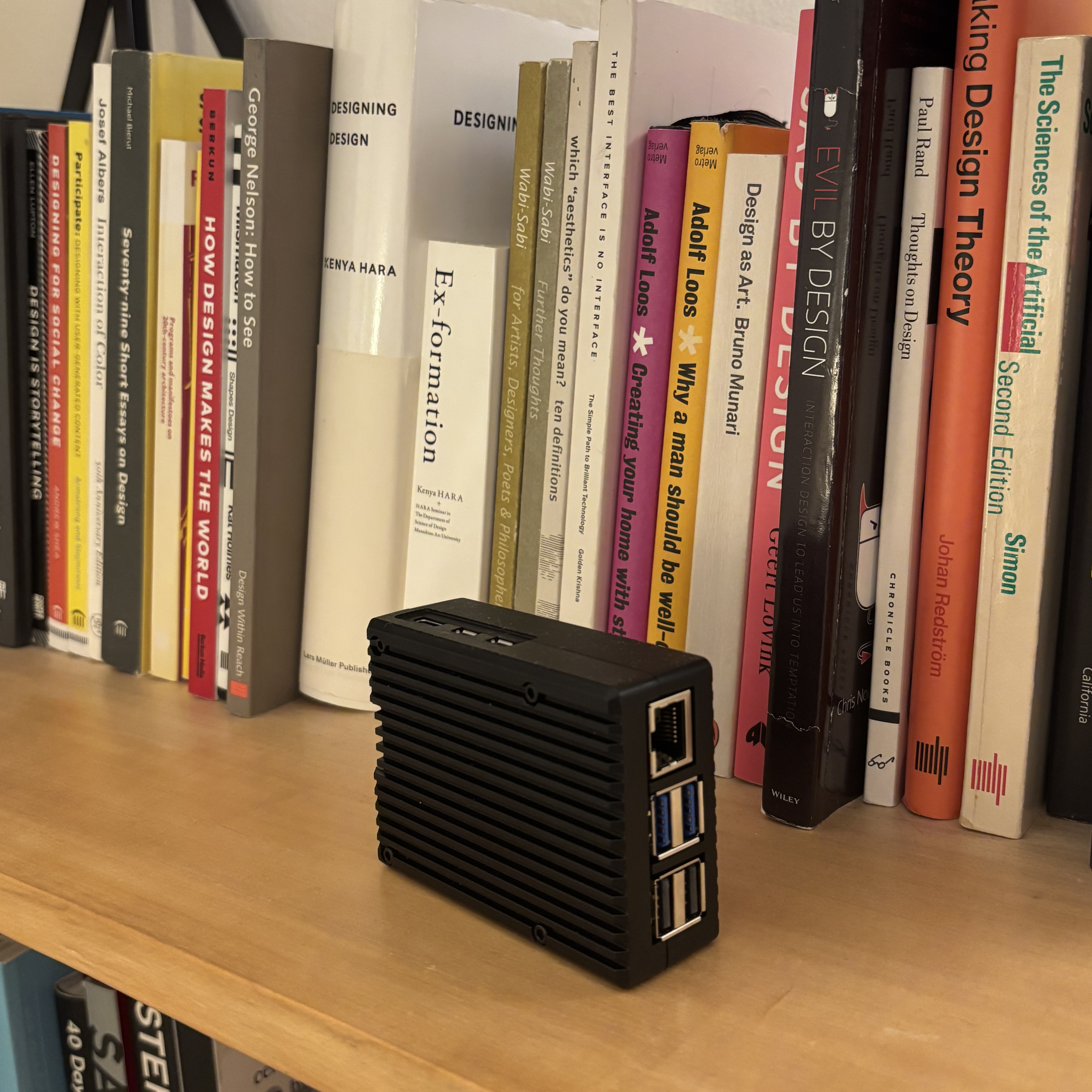
The proof of concept runs on a Raspberry Pi 5 8GB – sufficient for indexing and retrieval at modest scale, and a deliberate choice for validating the architecture on constrained hardware before committing to a more capable machine.
Design Decisions
Privacy by architecture. Documents and queries never leave the machine – not as a feature, but as a structural guarantee. There is no external service to configure, audit, or trust.
Transparency over confidence. Because AI can hallucinate and obscure its sources, ERIS returns passages with precise citations rather than synthesised answers. Null results are valid outputs – not failures to be papered over.
Assistive, not autonomous. ERIS surfaces what is in the collection and returns control to the researcher. Analysis, interpretation, and conclusion remain human work.